
DeKalb County Arrest Reports
The sheriff's office publishes no rolling 72-hour, weekly, or multi-day jail blotter. No photo policy, refresh schedule, or roll-off rule exists to quote. City coverage is spotty. The Sandwich Police Public Communications page stands out as the strongest person-specific source. Yet it runs as an episodic offense log. It is not a full jail roster. DeKalb Police keeps a press-release archive. Sycamore Police offers FOIA and annual-report channels with no verified daily list. Together they document agency activity, not everyone held in the DeKalb County Jail. Posts can trail an event by days. Keep incident date, post date, arrest date, and booking date separate.
Read DeKalb Arrest Reports
Start with the agency that handled the event. That habit prevents mix-ups. A city post is not a jail record, and a court docket is not live custody data.
- For Sandwich incidents, read the Offense Log and note event and publication dates separately.
- For DeKalb city events, search the official press-release archive by date and topic.
- For Sycamore, request a report through the city FOIA officer because no daily person-level log was verified.
- Check the Circuit Clerk for the later misdemeanor, felony, DUI, or traffic case.
- Use Sheriff FOIA for county-held booking material beyond published posts.
Current custody follows its own workflow. The Arrested Today page routes fresh checks to the jail and Illinois VINE.
Fields in DeKalb Arrest Reports
Sandwich posts give the best local example of what appears. Exact contents vary, and no entry equals a full county booking record.
| Field | How to read it |
|---|---|
| Event date | When the incident or arrest occurred, not always the post date. |
| Defendant detail | Identity must be checked against agency and court records. |
| Charge | An charge that may change as the case proceeds. |
| Location | The incident or arrest area, subject to lawful limits. |
| Processing outcome | May say transported, released, processed, or issued a Notice to Appear. |
| Court or destination | Can identify DeKalb County Jail or a later court route. |
| Photograph | No uniform city or sheriff web-photo rule was found. |
The arresting agency and the custodian are not the same thing. One Sandwich arrest might end in jail transport, a police release, or a court notice.
Delayed DeKalb Arrest Posts
No evidence points to a weekend surge or holiday update hour on any county page. Sandwich posts show the two dates diverging. DeKalb press releases are chosen announcements, not a complete arrest export. News runs on editorial schedules. So the newest post can hide an older arrest. Work backward by incident date, agency, and court destination. Then check the jail for custody and the court for a filed case. The county recent-arrests hub explains the difference between a police processing release and county custody.
DeKalb Arrest Report Archives
The sheriff's office posts no current retention schedule for modern booking records or photos. Illinois agencies follow Local Records Commission rules instead. A generic statewide period would mislead. Call the Sheriff Records Unit at (815) 895-7216 to ask which schedule applies and whether a file is still held, transferred, or lawfully disposed. The Illinois State Archives local-records FAQ explains that paper, photos, and electronic media can count as local records. DeKalb history runs deep. Sheriff jail registers from 1869 through 1951 and process dockets from 1890 through 1903 sit in NIU's Regional Archives Depository. Those are historical registers. They are not a modern mugshot archive. Note: A removed web post does not prove the agency destroyed its record, and a private copy can persist after release.
DeKalb Crime Briefs and Reports
Shaw Local's Daily Chronicle Crime Brief is the strongest local news section, and its Police Reports archive holds older summaries. Both are story-driven. Neither promises a same-day, weekend, or all-arrests window. A story may cite court papers or use a jail-supplied photo. That does not prove a public gallery exists. News explains an incident and its court movement. It cannot verify present custody. Confirm the name, charge, and status with the agency or court.
The local crime section's episodic format shows how these stories run.
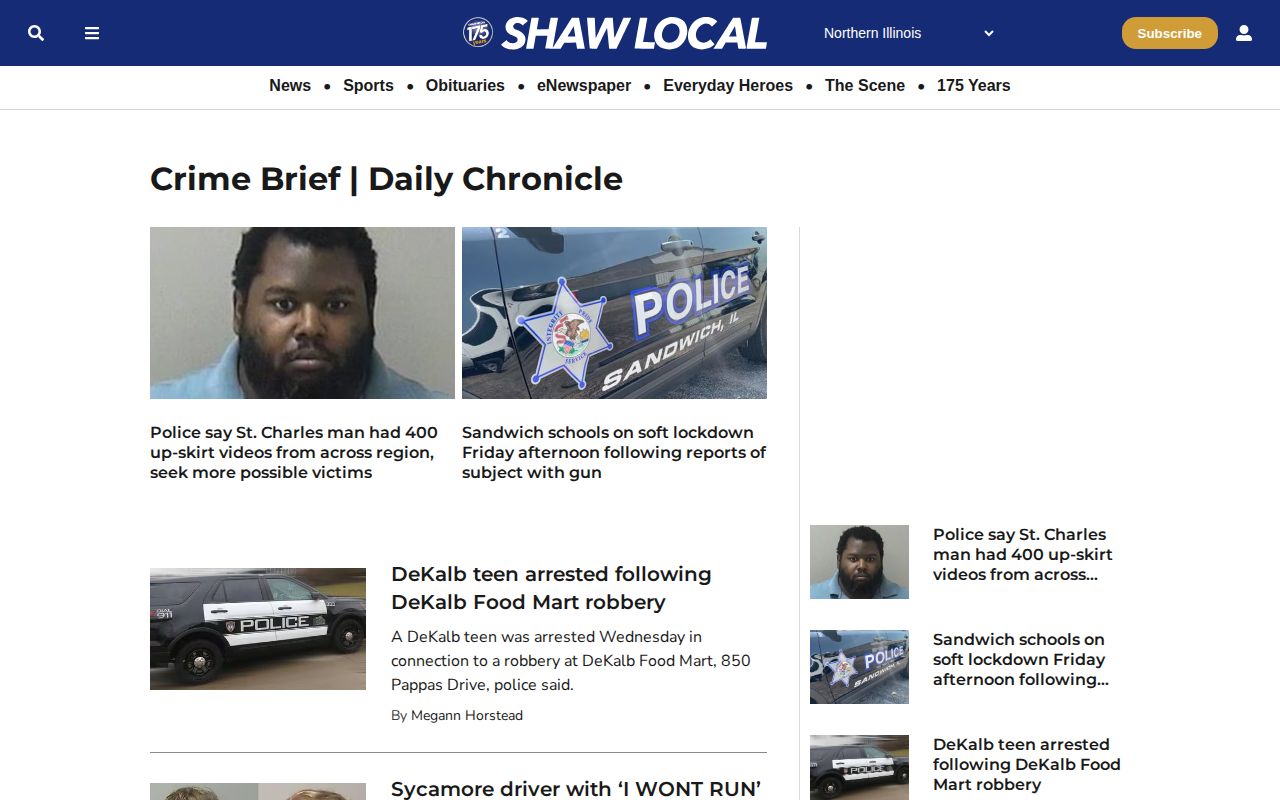
A newsroom's crime stories can never stand in for a full DeKalb County arrest log.
Unofficial DeKalb Arrest Archives
Private county pages offer browsing depth under their own rules. Busted Newspaper runs a paginated county archive. Mugshots.zone sorts entries into month buckets. None is an official DeKalb custody record. Official sources come first, because a private entry can be stale, duplicated, or tied to a charge later reduced or dismissed. For an accurate outcome, move from the originating agency to the Circuit Clerk. The older county index illustrates that role.
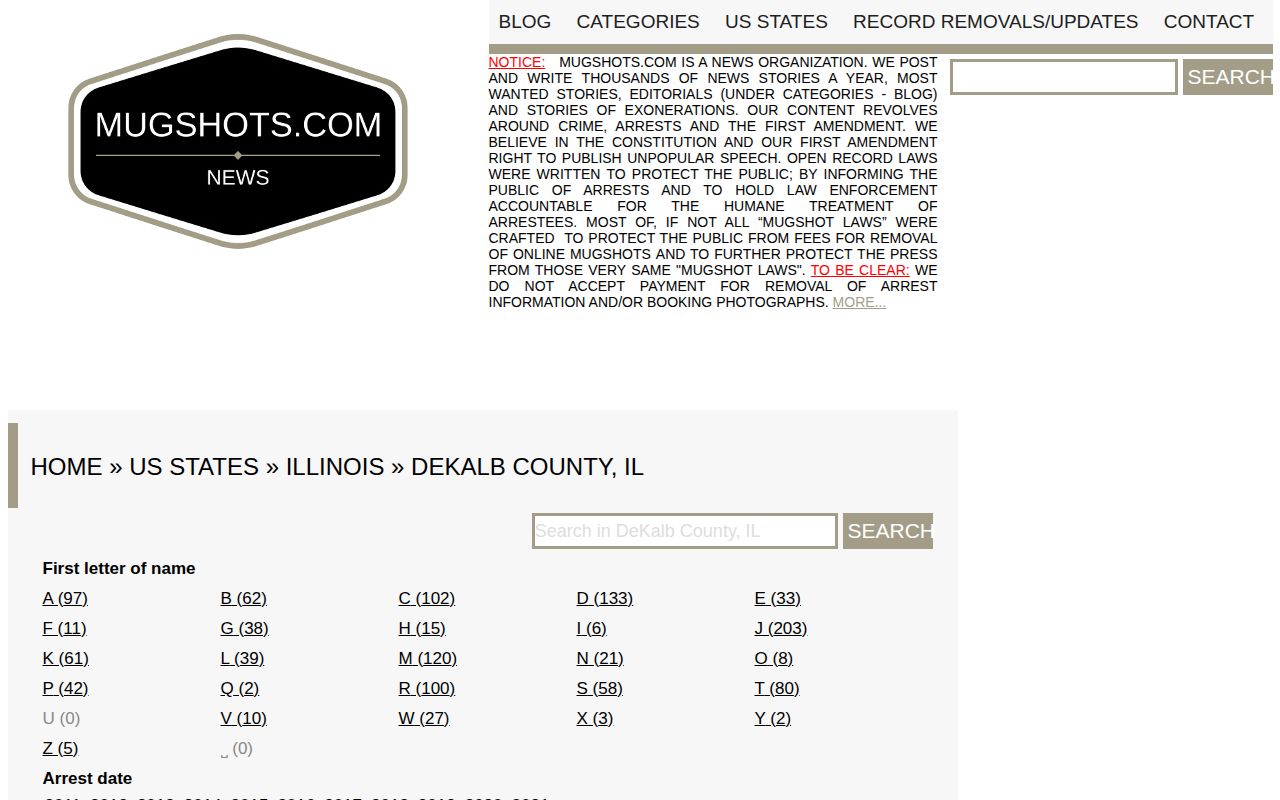
An old archive of DeKalb arrest names shows who was arrested, yet says nothing about who sits in custody now.
Request Older DeKalb Arrest Records
The sheriff's FOIA form is the formal route for older county booking reports and photos. Name the person, the date, and the place. The form also asks for the arresting agency and a report number if known. It wants a narrow description of the record you request. Delivery choices are listed. A five-business-day response is the stated norm. Juvenile, investigative, and safety-sensitive material can still fall under lawful exceptions. City files often stay with the originating police department. DeKalb, Sycamore, and Sandwich each run their own record channels under their own schedules. Ask the right custodian first. That saves delay and keeps a city incident report separate from a jail booking record.
DeKalb Arrests Versus Dispositions
An arrest report records a claim and a response. Bond text settles nothing. To follow the case afterward, use the Circuit Clerk's criminal search and the daily docket. The disposition, meaning the court's final resolution, tells you how the matter actually ended.
City Arrest Reports Differ
DeKalb's city archive posts selected police releases and announcements. It is not a daily list of everyone arrested. Sycamore gives readers a police contact, a FOIA officer, and annual reports, but no person-level daily blotter. Sandwich goes further, routing its old arrest-release page straight to the current Offense Log.
These gaps show up fast. A DeKalb arrest may surface as a selected release, a Sycamore record may take a written request, and a Sandwich matter may live in an episodic text post. County-jail custody is a separate layer. Start with the city source for the incident narrative. Then check the jail for present custody and the court for the outcome.
One more wrinkle: Sandwich spans DeKalb and Kendall counties. The court or destination listed in a post deserves a close look before you assume anything. Not every Sandwich police matter belongs in DeKalb County court or jail.
Follow a DeKalb Arrest Timeline
Put each record in order. The order is incident, arrest, police processing, jail booking if any, initial court activity, release or transfer, and disposition. Timing slides around. A press release may post well after the event. A booking record can carry an intake time later than the arrest time. A docket may appear after release. That is why multi-day research needs more than one source. It also stops you from reading an old private archive as live data. Note each source's date and role. Verify changes with the office that created it.
- Notice to Appear
- A direction to attend court without proof of county detention.
- Booking
- The jail intake event, distinct from the arrest.
- Bond
- A court-set release condition.
- Disposition
- The final court result.
Public Record Search
Sponsored Results